If you are planning a bound catalogue, the decision comes down to one question: how will people actually use it? Choose saddle stitch for a slim catalogue that will be handed out, perfect binding (glued spine) for a thicker one that should look like a book on a shelf, spiral or wire-o when it needs to lie flat, and a hardcover when longevity and prestige matter most. Below we explain when each method works, which mistakes it invites, and what to settle before you ask a printer for a quote.
Bound catalogue printing: start with how it will be used
Binding is not a finishing touch you pick after the design is done. It affects page layout, paper weight, spine width and even the cover design. Before requesting quotes, write down three things:
- Where will the catalogue be used? Handed out at a trade fair, carried in a sales rep’s bag, kept on a desk or a shelf?
- How long should it last? A seasonal product catalogue and a corporate brochure that stays unchanged for years do not need the same binding.
- How will readers handle it? Will pages be flipped constantly, will it sit open while someone fills in an order form, or will it be read cover to cover?
With those three answers, the differences between the options below become much clearer.
Catalogue binding types and what each is good for
Saddle stitch
Folded sheets are nested and stapled through the spine. It is flat, light and simple, and is common for slim catalogues, fair brochures and seasonal product lists. One firm rule applies: because every folded sheet gives four pages, the page count must be a multiple of four (8, 12, 16, 20…). If you designed 18 or 30 pages, you will need to add blank pages or rework the content. As page count grows, the inner pages push outward, so this method is not suited to thick catalogues; how many pages it handles well depends on the paper and the printer’s equipment.
Perfect binding (glued spine)
The spine edge of the pages is trimmed and glued to the cover, which produces a flat, book-like spine that can carry a title. It is widely used for higher page counts that will sit on shelves. Two cautions: if spine width is not accounted for in the design, the spine text will drift; and a glued spine does not open fully flat, so images and tables near the gutter can disappear into the fold. Keep generous inner margins. The minimum page count at which this method works well varies by printer, and sources give different thresholds, so confirm your page count directly with the printer.
Thread sewing
Signatures are sewn together with thread and then attached to the cover. This is generally considered more durable than a glued spine. Cost and production time are usually higher, so it makes sense for long-lived, frequently used catalogues.
Spiral and wire-o
The page edge is punched and a plastic or metal coil is threaded through. The catalogue lies completely open and can even fold back on itself. It suits price lists, product catalogues, technical manuals and anything used while working at a desk. The drawbacks: there is no spine, so no title on the shelf, and a crushed coil is hard to restore.
Hardcover (case binding)
The page block is fixed into a rigid board cover, which can be wrapped in cloth, coated paper or a leather-look material. It is the most durable and most prestigious option, suited to corporate presentation books, collections and annual brand-story publications. Cost and production time are higher than the others, so it is often unnecessary for high-volume giveaways.
Quick comparison
- Saddle stitch: slim, fast to produce, pages in multiples of four; no spine.
- Perfect binding: thicker catalogues, flat spine, shelf-friendly; needs wide inner margins.
- Thread sewing: durable; higher cost.
- Spiral / wire-o: lies flat; no spine, coil can be damaged.
- Hardcover: prestigious and long-lasting; the most expensive and slowest.
How binding changes the design
Knowing the binding at the start of the design saves rework later. Watch these points:
- Inner margins: Glued and sewn bindings do not spread fully flat, so keep text and images away from the gutter. For double-page spreads, allow for the area lost in the centre.
- Paper weight: Heavy paper makes a saddle-stitched spine bulge, and in spiral binding the sheet thickness decides the coil size. Ask the printer about cover and inner weights together with the binding.
- Page plan: Saddle stitch needs multiples of four; for other methods the printer’s sheet layout sets the page count. Confirm it before finishing the design.
- Spine text: For bindings with a spine, do not design it until thickness is fixed; use the spine width supplied by the printer.
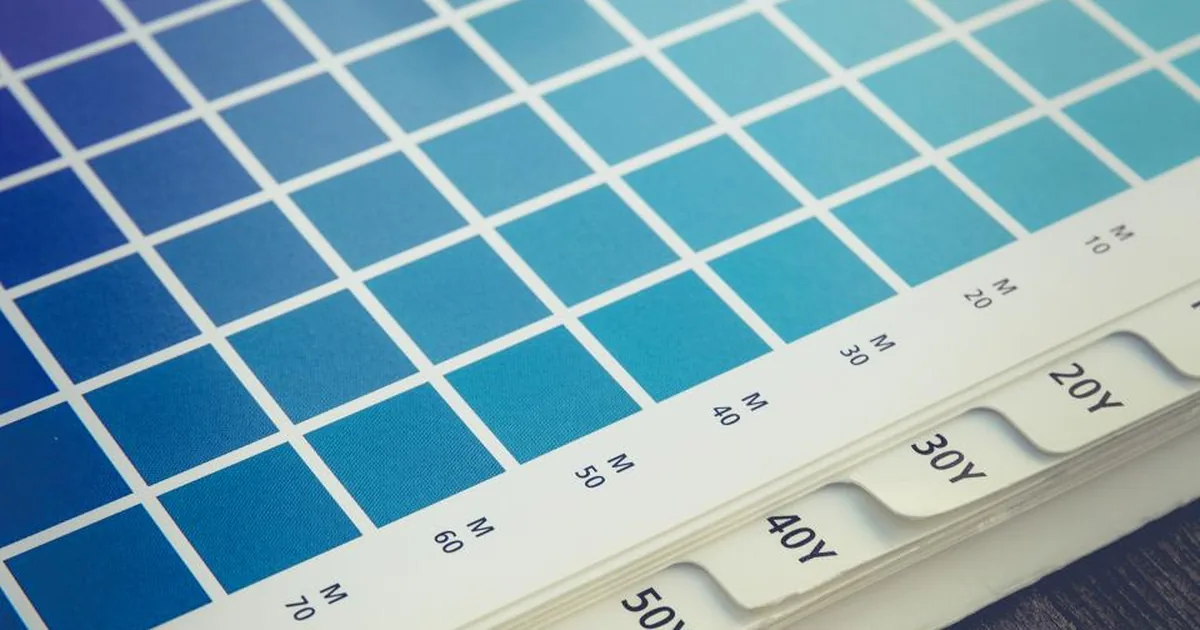
- Colour: Screen colour and printed colour will not match exactly; ask for a proof, especially for brand colours. See why print colour differs from the screen.
For the content itself — page flow, visual hierarchy and product presentation — our catalogue design tips will help.
What to give the printer when asking for a quote
Send the printer the following in one go so the quotes are consistent. Quotes based on incomplete information cannot be compared:
- Finished size (portrait or landscape, width and height).
- Page count, and whether the cover is included in it.
- Inner and cover paper type and weight; any surface finish for the cover, such as lamination or varnish.
- Binding type (if undecided, describe how it will be used and ask for the printer’s recommendation).
- Quantity, and alternative quantities if useful.
- Delivery date and delivery location.
Digital printing may make more sense for low quantities and offset for high ones, and that choice also affects binding cost. We cover it in digital or offset printing. Our guide on what to include when requesting a print quote also works as a checklist.
Common mistakes
- Leaving binding until last: If it changes after the design is finished, inner margins and page count have to be reworked.
- Guessing the page count: Forget the multiple-of-four rule for saddle stitch and you end up adding blank pages.
- Recommending hardcover for everything: For high-volume giveaways it inflates the budget needlessly.
- Skipping a sample: Seeing the paper, binding and colour combination in your hands reduces expensive surprises after printing.
- Ignoring update frequency: A price list that changes every season is better served by spiral or saddle stitch than by a hardcover.
Frequently asked questions
Which binding is best for a bound catalogue?
There is no single answer. Saddle stitch usually suits slim, fast jobs; perfect binding suits thicker shelf-style catalogues; spiral suits catalogues that must lie open; hardcover suits prestige and longevity.
Why must the page count be a multiple of four?
In saddle stitch, sheets are folded in the middle and each folded sheet makes four pages. If the total is not a multiple of four, blank pages must be added. For other bindings, page layout depends on the printer’s sheet plan.
How many pages are needed for perfect binding?
The minimum depends on the printer, paper and machine, and different sources give different values. State your page count and paper weight and get written confirmation from the printer.
Does a spiral-bound catalogue look professional?
Yes, if it fits the purpose. It is practical for price lists, product catalogues and manuals that are opened often and used on a desk. For a prestige-oriented corporate book, sewn or hardcover binding is usually preferred.
In short
When you commission a bound catalogue, look first at how it will be used, then at page count and quantity; the binding follows from those answers. Planning the design together with the binding decision and giving the printer complete information saves both time and mistakes. If you would like support with catalogue printing and design, see our catalogue printing service or send your requirements through the quote form.