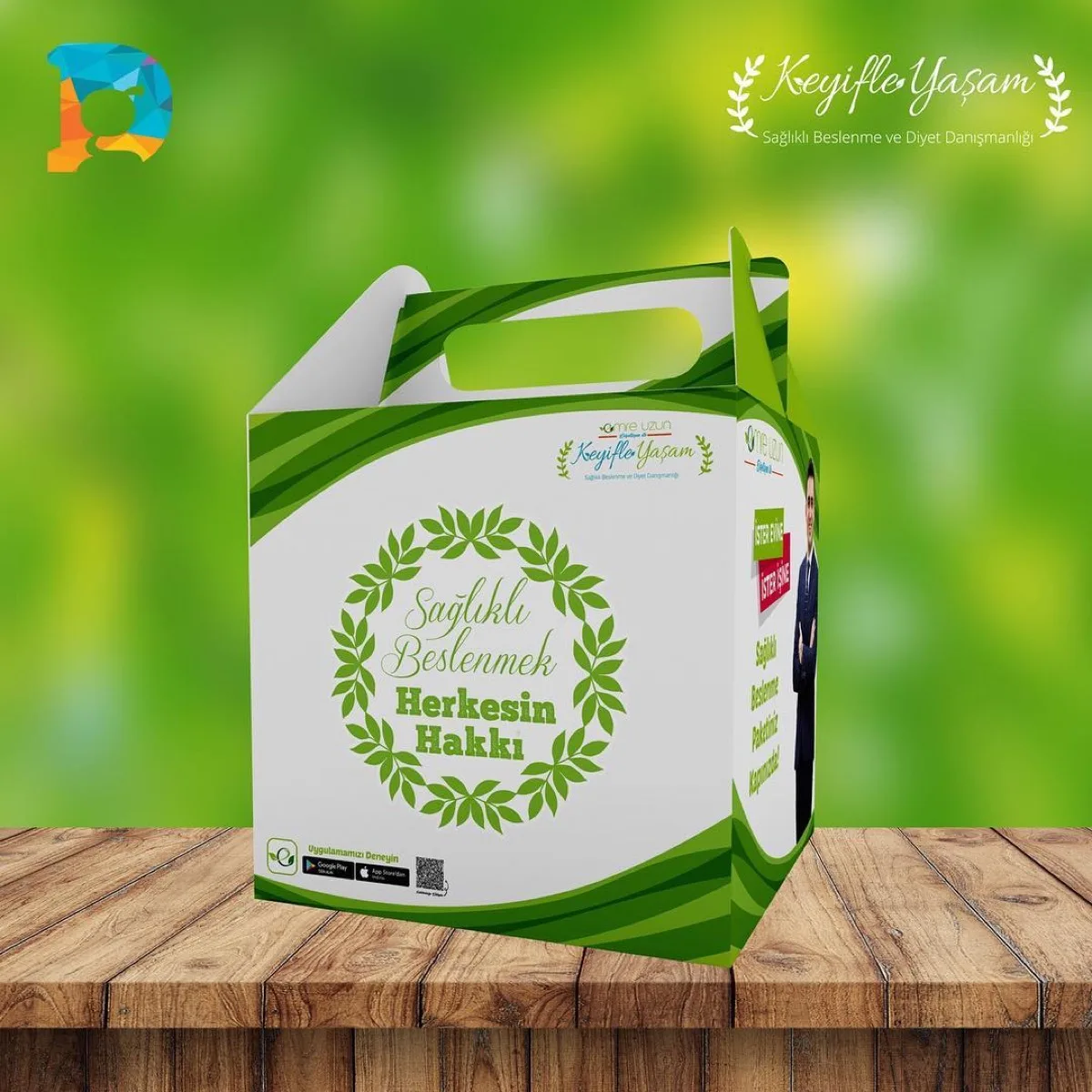
Packaging is a three-dimensional construction rather than a flat design. The dieline determines which faces are seen and which fold away inside; when artwork is not laid onto that template, a logo can land on a crease or a product name disappear under a glue flap.
Board is chosen by the weight of the product. Folding boxboard suffices for light cosmetics, while heavier or fragile goods need a corrugated structure. Printing on corrugated loses fine detail and small type, so the design has to be simplified accordingly.
Shelf visibility depends less on the front face than on the top and sides. Where products stand side by side, often only the narrow face is visible; making the brand name legible there does more work than the design on the wide face.
The cutting form is paid for once and reused afterwards. Choosing a standard box size often means an existing form can be used and the cost never arises; when a custom shape is needed, the form is produced once, kept, and not paid for again on a repeat order. That makes the dimension decision something to settle before the design.
How the box assembles affects both production and storage. A lock-bottom sets up quickly by hand and needs no extra gluing; a glued base is safer for heavy products but adds assembly time. If stackability is ignored, boxes will not sit squarely on each other and warehouse space is lost.

Technical options
- Structures
- Tuck-end, glued carton, corrugated shipper, sleeve box
- Board
- Folding boxboard, kraft, corrugated (E and B flute)
- Finishes
- Lamination, varnish, foil, window patching
- Tooling
- Custom cutting die from the dieline
Related services
Frequently asked
What is needed to design packaging?
The product's dimensions and weight, along with the intended shelf arrangement where one exists. Designs prepared without these two usually go back for revision at production.
Is a new cutting die made for every order?
The same die is reused as long as the dimensions do not change. The tooling cost therefore appears on the first order and drops out of repeat runs.
Can detailed artwork print on corrugated board?
Fine lines and small type do not reproduce cleanly because of the surface texture. High-contrast, simplified, larger-scale designs work far better on corrugated.
Can I see a sample before packaging is produced?
A blank mock-up, cut and folded, can be prepared before the cutting form is made. It shows whether the product sits correctly inside and whether the lid closes comfortably, all before anything goes to print.
What matters for food packaging?
Any surface in direct contact with the product needs food-safe material and inks. Where there is direct contact, the inner face is left unprinted or given a suitable barrier coating.
Why does packaging take longer than other jobs?
Because there are two stops along the way: the cutting die and the sample. Printing cannot begin before the box is unfolded into a dieline and the tool is made, and the first sample has to be folded and tried. When those steps are skipped the problem that surfaces is usually not in the print but in a box that will not close, and at that point the job starts over.
Are boxes delivered ready-assembled?
They arrive flat and unformed. Carrying an assembled box means carrying the empty space inside it, which is preferred neither for room nor for cost. Assembly takes a few seconds at your end. The cutting die stays tied to where it was made, much as with labels, and repeat runs are planned with that in mind.
How should I hand over the packaging file?
The dieline and the artwork belong in the same file at actual size but on separate layers. When fold and glue allowances are distinguished by colour, there is no ambiguity about which line is cut and which is creased. Background colour or imagery is extended a little past the cut line rather than stopping at it.
Why does a small packaging run cost more per unit?
Because the cutting die is a one-off preparation whose cost does not depend on how many boxes are printed. The same tool costs the same for a hundred boxes as for a thousand, so as the quantity falls the share carried by each box grows. When a repeat run uses the same die that line does not appear again, which is why a second order is calculated quite differently.